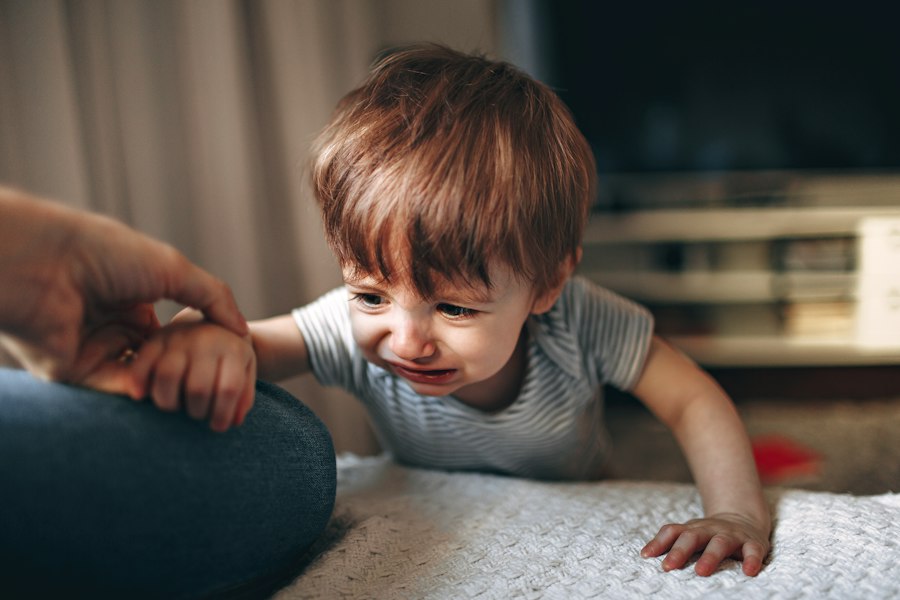
Your child just looked you in the eye and said "I hate you" — and it landed like a slap. If you're searching for what to say when your child says "I hate you," here's the short answer: stay calm, don't take it personally, and respond with something like, "That's a big feeling. I still love you, and I'm not going anywhere." The words themselves are not a verdict on your parenting — they're a signal of overwhelm.
It happens most often after a limit gets set: no more screen time, bedtime arrives, a toy gets taken away. In that moment, your child's brain doesn't have the words for "I'm furious that you said no and I don't know how to handle this feeling," so it reaches for the biggest weapon available: three words guaranteed to get a reaction. This article walks through why kids say it, the exact scripted response that works across ages, and what to do if it happens constantly. It pairs with our complete guide on how to stay calm as a parent and, if hitting is also part of the picture, what to do when your child hits you.
💡 The core insight: "I hate you" is rarely about hate. It's an emotional overflow valve — a child's nervous system announcing it's over capacity. Your job isn't to correct the words; it's to help the feeling pass through safely.
Why Kids Say "I Hate You" (It's Not What You Think)
Neuroscience gives us a clear picture here. The prefrontal cortex — the part of the brain responsible for regulating emotion, weighing consequences, and choosing words carefully — isn't fully developed until the mid-20s. In a young child, it's barely online at all. When a child is flooded with anger, disappointment, or humiliation, the amygdala (the brain's alarm system) takes over, and whatever comes out of their mouth is the verbal equivalent of a slammed door.
What's Actually Happening Underneath
- Limited emotional vocabulary — a 4-to-9-year-old often doesn't have words for "frustrated," "humiliated," or "powerless," so "I hate you" becomes the catch-all
- Testing the relationship's floor — some children are unconsciously checking: will you still love me even when I say the worst thing I can think of?
- Mirroring intensity — kids often escalate their language to match how big the feeling is inside, even if the trigger (a screen-time limit) looks small to you
- Learned effectiveness — if the phrase has ever produced guilt, a reversed decision, or a big reaction from you, the brain quietly files it as "this works"
Dr. Daniel Siegel and Dr. Tina Payne Bryson describe this as the "downstairs brain" taking over — the reactive, instinctual part — while the "upstairs brain," responsible for reasoned language, is temporarily offline. Their book The Whole-Brain Child covers this exact mechanism in more depth if you want to go further. (See it here.)
The Script: What to Say in the Moment
You don't need a long speech. Long speeches don't land with a flooded nervous system anyway. You need a short, steady response that does three things: names the feeling, holds the boundary, and reaffirms the relationship.
The 3-Part Response
- Name it, don't fight it: "You're really angry with me right now." (Not: "Don't you ever say that to me again.")
- Hold steady: "The answer is still no." or "Bedtime is still happening." (The limit doesn't move just because the words got bigger.)
- Reaffirm the bond: "I still love you, even when you're this mad at me. That's not going to change."
Said together, in a calm and even tone: "You're really angry with me right now, and the answer is still no. I still love you, even when you're this mad at me." That's the whole script. It works for a 4-year-old and, with slightly different phrasing, a 12-year-old.
By Age: How to Adjust the Words
- Ages 3–5: Keep it very short and physically calm. "That's a big mad. I'm right here." Get to their eye level if they'll let you; don't force closeness if they're pulling away.
- Ages 6–9: You can add a touch more reflection: "Sounds like you're really disappointed I said no to the tablet. That's allowed. The answer is still no."
- Ages 10+: Older kids can often handle — and need — a follow-up later: "Earlier you said you hate me. I'm not mad about it, but I'd love to understand what was going on for you. Want to talk about it later?"
💡 Scripts like this one — for tantrums, back-talk, sibling fights, and a dozen other flashpoints — are laid out day-by-day in The Mindful Family Handbook. Available now at calmimo.com.
What NOT to Do (Even Though It's Tempting)
In the heat of the moment, a few reactions feel natural — and almost all of them backfire.
- Don't say "That's a horrible thing to say": it shames the child for having a feeling, rather than addressing the feeling itself. Shame tends to intensify the behavior, not reduce it.
- Don't say "Well I don't like you either": matching a child's dysregulation with your own teaches that this is how adults handle big feelings, and it damages trust.
- Don't cave on the limit: reversing your decision because the words hurt teaches that "I hate you" is a lever that moves you. That guarantees you'll hear it again.
- Don't over-explain or lecture in the moment: a flooded brain can't absorb reasoning. Save any teaching conversation for later, once everyone is calm.
- Don't punish the words themselves: consequences for the phrase "I hate you" (as opposed to consequences for hitting or breaking something) tend to suppress the expression while leaving the underlying feeling — and the behavior it triggers — untouched.
If tantrums or hitting are also showing up around these same moments, our guide on mindful parenting techniques covers how to lower your own reactivity so these flashpoints de-escalate faster instead of spiraling.
Should You Address It Afterward?
Yes — but only once everyone, including you, is fully calm. Timing matters more than content here. A conversation attempted mid-meltdown will not land; the same conversation an hour later, at bedtime, or the next morning, often will.
A Simple Follow-Up Script
Once things are settled: "Earlier you told me you hate me. I wasn't hurt by it — I know you were really upset about [the tablet / bedtime / the toy]. Next time you're that mad, you can tell me 'I'm SO mad at you' instead — I'll still understand exactly how big the feeling is."
This does two things: it removes any lingering shame from the moment, and it hands your child a slightly more precise tool for next time — without demanding they never feel that angry again.
When It Happens Constantly
An occasional "I hate you" during a hard moment is developmentally normal and not a red flag. If it's happening multiple times a day, across many different triggers, it's worth looking at the bigger picture rather than just the phrase itself.
- Check the household's emotional climate: children absorb tension between parents, work stress, or a chaotic home rhythm and often express it as generalized anger. A steadier morning routine and bedtime routine remove a lot of daily friction points.
- Look at how limits are being set: limits delivered with yelling or sudden authority tend to provoke bigger reactions than limits delivered calmly and predictably. Our guide on how to stop yelling at your kids is a good next step if this sounds familiar.
- Rule out overload: hunger, exhaustion, over-scheduling, and too much screen stimulation all lower a child's threshold for frustration dramatically.
- Consider extra support: if the intensity or frequency feels beyond typical, or is paired with aggression toward others, a pediatrician or child therapist can rule out underlying anxiety or regulation difficulties.
For scripts specifically on staying grounded when a child escalates further — yelling, name-calling, slamming doors — How to Talk So Kids Will Listen has some of the clearest, most usable language we've come across. (See it here.)
Want the Full Script Library for Moments Like This?
The Mindful Family Handbook gives you 50 structured days of calm-parent tools — including word-for-word scripts for tantrums, defiance, sibling conflict, and exactly these kinds of gut-punch moments.
Get the Guide — calmimo.comFrequently Asked Questions
What does it mean when my child says "I hate you"?
It almost always means "I'm overwhelmed by a feeling I don't have words for," not literal hatred. Young children's brains route big frustration, disappointment, or humiliation through whatever language is available — and "I hate you" is one of the first phrases that reliably gets a strong reaction, so it becomes the default.
Should I punish my child for saying "I hate you"?
Punishing the phrase itself tends to backfire — it adds shame on top of an already dysregulated child, without teaching a better way to express the feeling. It's more effective to hold your original limit steady, respond calmly, and revisit the moment later with a simple, non-punitive conversation once everyone is calm.
Is it normal for a toddler or young child to say "I hate you"?
Yes — it's developmentally typical, especially between ages 3 and 9, when emotional vocabulary is still limited and impulse control is still developing. Occasional outbursts during hard moments (a denied request, a transition, a consequence) are not a sign of a deeper problem.
How do I respond without losing my own temper?
Remind yourself in the moment that the words are about your child's internal state, not a judgment of you. A brief pause — even a single slow breath before responding — helps keep your own nervous system out of the fight. Our guide on how to stay calm as a parent has more tools for this exact situation.
When should I worry about how often my child says this?
Occasional use during clear triggers (limits, transitions, disappointment) is normal. If it's happening many times a day, escalating in intensity, or paired with aggression toward people or animals, it's worth checking in with a pediatrician or child therapist to rule out anxiety, sensory overload, or a regulation difficulty that needs extra support.